


The Prosperity category of the PSAU SDG–RFP is focused on contributions (projects, applications, and policies) aimed at spurring economic growth, creating jobs, and development of sustainable infrastructure within the PSAU host communities, nationally, and globally.
The University will invest on contributions related to projects, policies, and applications supporting:
•Technology-based entrepreneurship and digital innovation initiatives, support for start-ups, and leveraging technology to drive innovation and competitiveness.
•Use of technology in job creation and skills development initiatives promoting inclusive and sustainable economic growth, particularly by creating jobs for youth and vulnerable populations, as well as enhancing digital skills through training and capacity-building programmes.
•Sustainable infrastructure initiatives that leverage technology for the planning, development, and maintenance of resilient and sustainable communications, digital connectivity, energy, transport, or other services.
•Technological frameworks support financial inclusion initiatives geared towards expanding access to finance and enhancing digital payment systems to support economic growth and empower individuals and businesses.
Leveraging technology to drive industrial transformation and sustainable production initiatives to support sustainable and responsible practices, including circular economy models, resource efficiency, and sustainable production and consumption patterns.
Activities and programmes under the Prosperity category of the PSAU SDG–RFP should align particularly with:
Decent Work and Economic Growth
Industry, Innovation, and Infrastructure
Partnerships for the Goals
PSAU Progress, policy and progress against SDG16
PSAU gives SDG 16 special attention by implementing legislation and rules to maintain peace and justice in the university environment and system. The election of student unions at all levels is one of the key practices that the institution fosters and promotes good governance. The university organized a number of programs with this goal in mind.
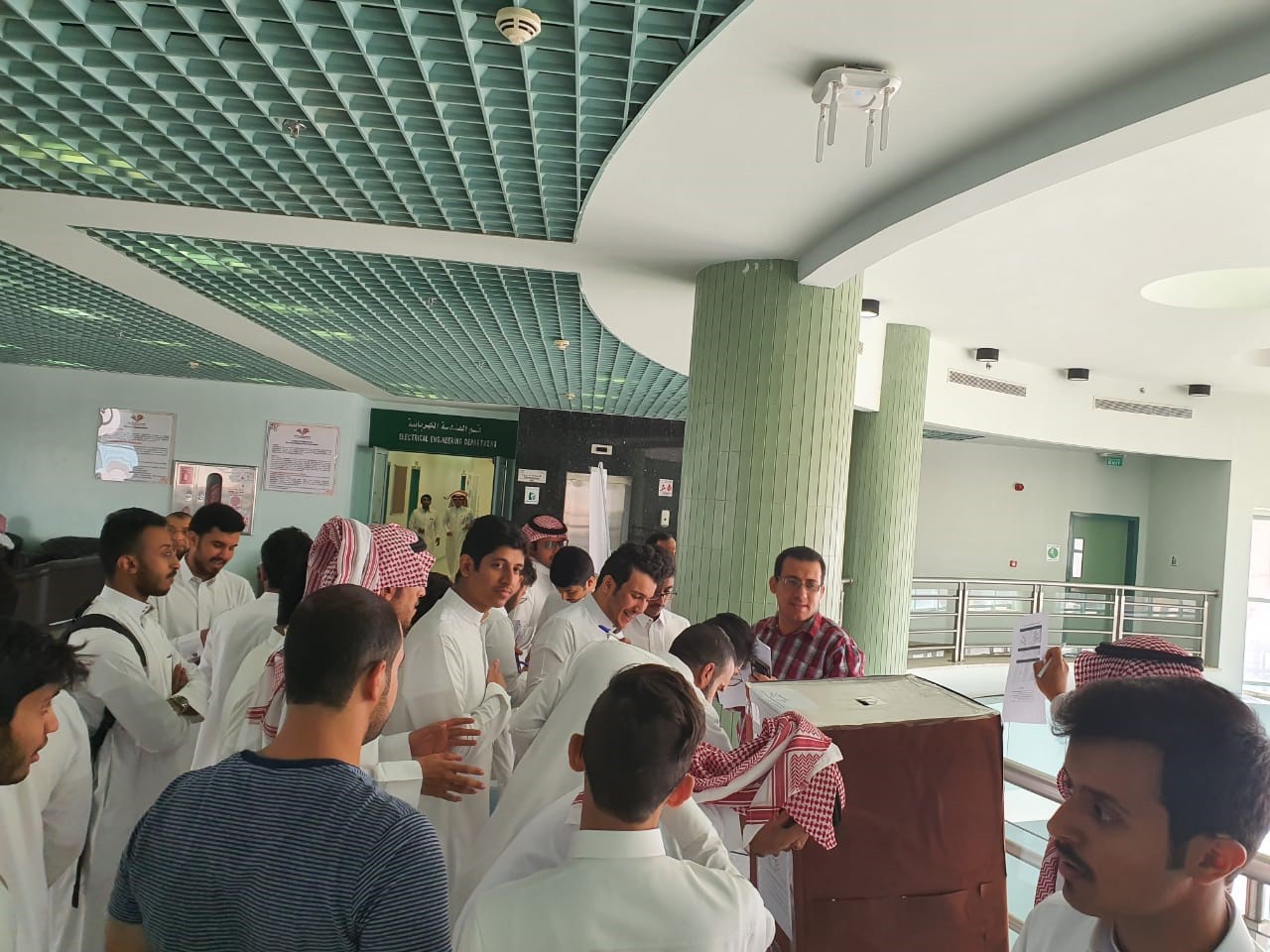
Student’s Union elections (college of Engineering)
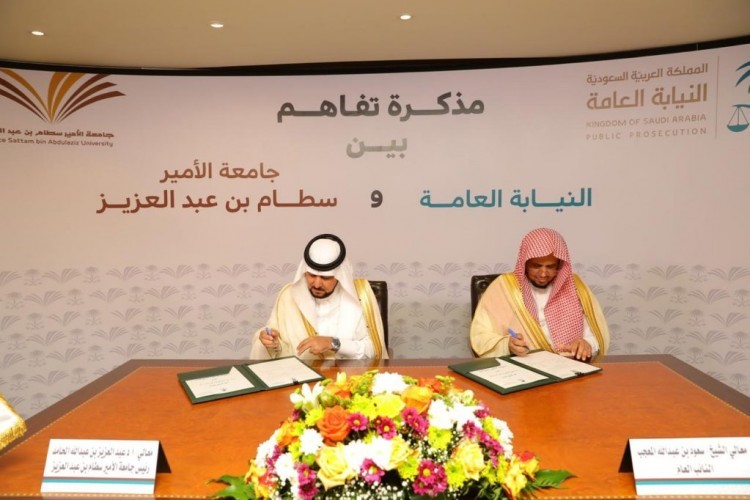
Memorandum of understanding between the PSAU and general prosecution in collaboration in education and training
Previous PSAU rector Professor Abdulaziz Alhamid commented on the formulation of a higher standing committee for anti-corruption
PSAU policies
Organise election for students representatives for students unions and clubs
Strong collaboration with stakeholders, government, local community
Supporting peace and justice through education programs
Encourage scientific publications peace, justice and transparency.
Formation of standing committee for good governance and anticorruption at the University level
Picture 1: Student’s Union elections (college of Engineering)
Picture 2:Memorandum of understanding between the PSAU and general prosecution in collaboration in education and training
Noting that its Sustainable Development Goals (SDGs) can only be realized with strong global partnerships and cooperation, the United Nations earmarks SDG 17 as pivotal for the success of the SDGs. Therefore, the goals of SDG 17 comprise of 19 targets carefully grouped into areas that traverse all the 16 SDGs as enumerated below.
Finance
17.1 Strengthen domestic resource mobilization, including through international support to developing countries, to improve domestic capacity for tax and other revenue collection
17.2 Developed countries to implement fully their official development assistance commitments, including the commitment by many developed countries to achieve the target of 0.7 per cent of ODA/GNI to developing countries and 0.15 to 0.20 per cent of ODA/GNI to least developed countries ODA providers are encouraged to consider setting a target to provide at least 0.20 per cent of ODA/GNI to least developed countries
17.3 Mobilize additional financial resources for developing countries from multiple sources
17.4 Assist developing countries in attaining long-term debt sustainability through coordinated policies aimed at fostering debt financing, debt relief and debt restructuring, as appropriate, and address the external debt of highly indebted poor countries to reduce debt distress
17.5 Adopt and implement investment promotion regimes for least developed countries
Technology
17.6 Enhance North-South, South-South and triangular regional and international cooperation on and access to science, technology and innovation and enhance knowledge sharing on mutually agreed terms, including through improved coordination among existing mechanisms, in particular at the United Nations level, and through a global technology facilitation mechanism
17.7 Promote the development, transfer, dissemination, and diffusion of environmentally sound technologies to developing countries on favourable terms, including on concessional and preferential terms, as mutually agreed
17.8 Fully operationalize the technology bank and science, technology. and innovation capacity-building mechanism for least developed countries by 2017 and enhance the use of enabling technology, in particular information and communications technology
Capacity building
17.9 Enhance international support for implementing effective and targeted capacity-building in developing countries to support national plans to implement all the sustainable development goals, including through North-South, South-South. and triangular cooperation
Trade
17.10 Promote a universal, rules-based, open, non-discriminatory. and equitable multilateral trading system under the World Trade Organization, including through the conclusion of negotiations under its Doha Development Agenda
17.11 Significantly increase the exports of developing countries, in particular with a view to doubling the least developed countries’ share of global exports by 2020
17.12 Realize timely implementation of duty-free and quota-free market access on a lasting basis for all least developed countries, consistent with World Trade Organization decisions, including by ensuring that preferential rules of origin applicable to imports from least developed countries are transparent and simple, and contribute to facilitating market access
Systemic issues
Policy and institutional coherence
17.13 Enhance global macroeconomic stability, including through policy coordination and policy coherence
17.14 Enhance policy coherence for sustainable development
17.15 Respect each country’s policy space and leadership to establish and implement policies for poverty eradication and sustainable development
Multi-stakeholder partnerships
17.16 Enhance the global partnership for sustainable development, complemented by multi-stakeholder partnerships that mobilize and share knowledge, expertise, technology. and financial resources, to support the achievement of the sustainable development goals in all countries, in particular developing countries
17.17 Encourage and promote effective public, public-private, and civil society partnerships, building on the experience and resourcing strategies of partnerships
Data, monitoring and accountability
17.18 By 2020, enhance capacity-building support to developing countries, including for least developed countries and small island developing States, to increase significantly the availability of high-quality, timely and reliable data disaggregated by income, gender, age, race, ethnicity, migratory status, disability, geographic location and other characteristics relevant in national contexts
17.19 By 2030, build on existing initiatives to develop measurements of progress on sustainable development that complement gross domestic product, and support statistical capacity-building in developing countries
Through its separate policies for the respective SDGs, PSAU is vigorously pursuing the attainment of the the enumerated targets. In this, the University is guided by Kingdom level targets and objectives as provided via different governmental Ministries, Departments, and Agencies (MDAs). Furthermore, the University has entered into numerous Memorandum of Understanding (MoUs) with other Non-Governmental Organisations (NGOs) to support its aspirations in each SDG.
This document outlines the PSAU policies, accomplishments, and targets for the SDGs in the short, mid, and long-term.
