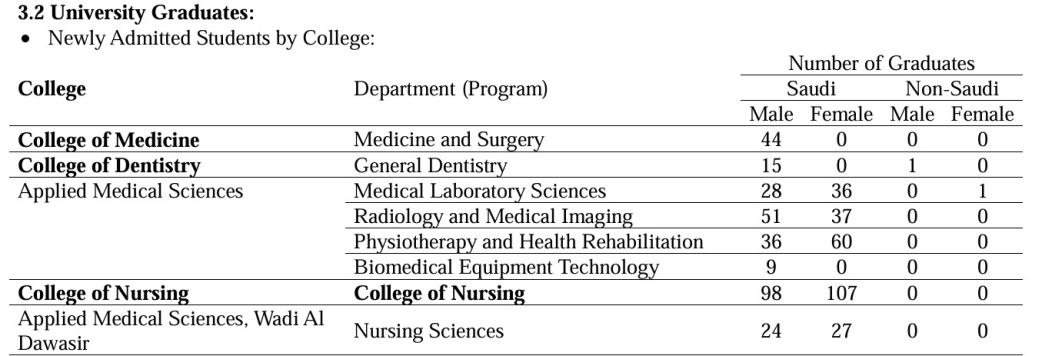
Graduation and Completion Rates
While the university graduates approximately 4,800 to 5,300 students annually across all genders, specific data for female students indicates strong retention and success:
Postgraduate Success: In specialised programmes like the M.Sc. in Statistics, female completion rates reached 100% in 2023 and 2024, with a slight adjustment to a high rate in the most recent May 2025 cohort.
Academic Support: PSAU actively monitors female student progress through dedicated academic advising and mentoring systems to ensure high retention.
New Opportunities: To further enhance female graduation in STEM, the university recently established new programmes for women in Electrical Engineering (2023) and Nursing (2024).
Contextual Performance
PSAU aligns with broader Saudi Arabian trends where female enrollment and completion in higher education have surpassed those of males in recent years.
National Benchmark: According to latest reports, Saudi women make up approximately 49.99% of all higher education students nationally, with high concentrations in business, management, law, and humanities.
Strategic Growth: The university’s recent expansion into qualitative graduate programs, including a PhD in Computing, has seen a 142.3% growth in accepted students, including a significant portion of female candidates.
Based on the enrolment and graduation trends 2023-2025, PSAU has both evidence of strong female performance and clear levers to further close any remaining gaps between female and male graduation outcomes, particularly in STEM and postgraduate programmes.
Graduation trends @ PSAU
Female completion is consistently strong in specialised postgraduate programmes. In the M.Sc. Mathematics cohorts, female students achieved 100% completion in 2023 and 2024, with only a marginal decline in the most recent cohort, which remains high. This indicates that once enrolled, female students demonstrate strong persistence and academic success.
Female enrolment is growing steadily, with recent cohorts showing higher overall intake and a rising proportion of female students. This suggests increasing demand and confidence in postgraduate pathways among women.
Male and female graduation gaps appear programme-specific rather than systemic, with female outcomes often matching or exceeding male outcomes in small and medium-sized cohorts.
Measures and schemes to further improve female graduation outcomes
Drawing on recent trends and existing institutional practices, PSAU is well positioned to further strengthen female graduation rates through the following measures:
Targeted mentoring and cohort-based support
Expanding structured mentoring schemes, such as the i-Women programme, to earlier stages of postgraduate study and final-year undergraduate cohorts can replicate the high completion rates observed in specialised programmes. Small-cohort mentoring has proven particularly effective for female students.
Early academic progress monitoring
The data suggest that completion rates remain highest where progress is closely monitored. Strengthening early-warning systems and personalised academic advising for female students in mathematically intensive or high-risk modules can prevent attrition before it occurs.
Programme design aligned with female participation trends
The successful launch of women-focused programmes in Electrical Engineering and Nursing demonstrates that targeted programme design increases female enrolment and retention. Applying similar design principles to other STEM programmes is likely to improve graduation outcomes further.
Flexible progression and workload management
Given the strong outcomes in cohorts with smaller class sizes and structured delivery, maintaining flexible study pathways, balanced workloads, and predictable progression milestones will continue to support female persistence through to graduation.
Role modelling and leadership pathways
Leveraging successful female graduates and faculty as mentors and role models reinforces aspiration and retention, particularly in cohorts where female participation is still emerging.
Conclusion
The available data indicate that PSAU does not face a systemic disadvantage in female graduation outcomes. On the contrary, female students often outperform male peers in completion and retention. By scaling existing mentoring, advising, and programme-design practices—particularly those embedded in the i-Women and postgraduate support frameworks—the University can further consolidate and sustain female graduation success, effectively closing any residual gender gaps.

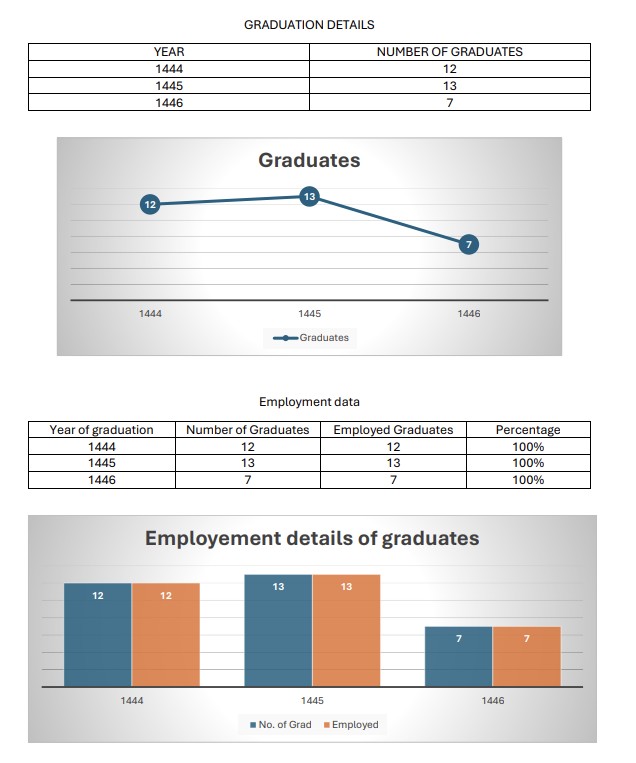
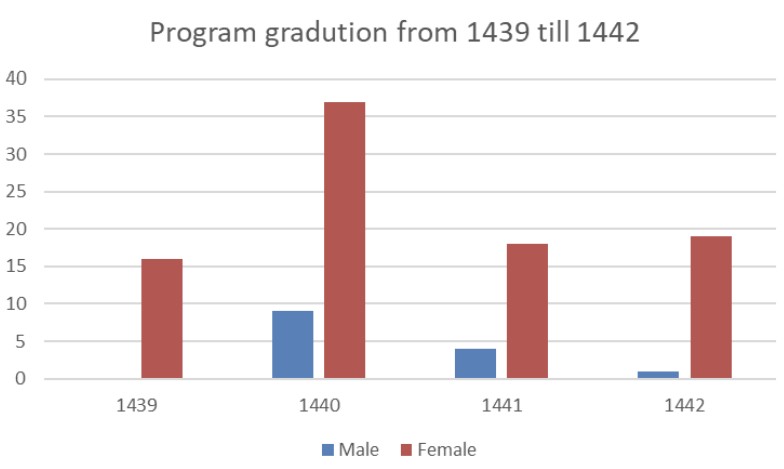
Measurement and Tracking of Women’s Graduation Likelihood Compared to Men’s, and Schemes to Close Any Gap
Prince Sattam Bin Abdulaziz University (PSAU) maintains a formal, data-informed, and gender-sensitive framework to monitor and support female students' progress toward graduation. The University systematically tracks gender-disaggregated data across application, admission, enrolment, retention, and graduation metrics and uses this information to inform targeted support programmes that foster equity and academic success for women.
1. Measurement and Monitoring Framework
PSAU integrates gender-based tracking into its student information systems and academic readiness assessments. Key activities include:
- Annual Readiness and Progress Tests: Administered at multiple academic stages, these assessments capture data on enrolment and academic performance by gender. For example, in the 2024/2025 academic year, women constituted 53% of the student population tested for university readiness.
- Comparative Benchmarks: Graduation and progression trends are reviewed by the Deanship of Admission and Registration and analysed alongside national targets to detect emerging disparities.
Graduation Rate Monitoring: Internal performance monitoring reports document graduation outcomes by cohort and gender. In selected postgraduate programmes such as MSc Statistics, female graduation rates reached 100% in 2023 and 2024, with an 85.7% rate in 2025.
2. Schemes to Close Gender Gaps in Graduation
Where disparities or vulnerabilities are identified, PSAU has instituted targeted schemes to close graduation gaps and promote women's retention and completion. These include:
- Mentoring and Academic Support
- Scholarships and Financial Aid for Women
- Gender-Inclusive Programme Design
- Monitoring and Adaptive Strategy
PSAU’s policy on mentoring and academic support for female faculty and students outlines institutional commitments to structured advising, peer support groups, and academic skills enhancement for women. These efforts ensure women—particularly those in STEMM disciplines—are supported from entry to graduation.
Female students benefit from merit-based and needs-based scholarships designed to reduce economic barriers to graduation. Targeted financial support is also extended to women returning from maternity leave or those undertaking research-based projects.
PSAU has introduced new academic offerings specifically aimed at improving women’s access and retention in traditionally male-dominated fields, such as Electrical Engineering and Computing, where significant increases in female enrolment were reported from 2023 onward.
Through its numerous outreach programmes, PSAU engages and encourages female applications in all its programmes, particularly where they are underrepresented. In this regard and thanks to the phenomenal changes taking place in the kingdom, the University will be commencing extending admissions to programmes where female enrolment was hitherto not available. In Spring 2022, PSAU welcomed its first ever cohort of female electrical engineering (EE) students.
In 2024, PSAU established a full-fledged College of Nursing for female students in Al-Kharj. Additionally, the university officially opened its female campus, which brings all the female programmes under one roof.
Scholarships and other support are extended to female students across all programmes and courses in the university.
Furthermore, as part of its annual SDG-focused student training at Imperial College London, PSAU reserves seats dedicated for female students.
Through these policies and activities, PSAU encourages applications and enrolment of women in subjects where they are underrepresented. This aligns with the Saudi Vision 2030 initiatives that mandate female representation and participation in all facets of life.